Sound and Music
Make one level, The Music Box, a crypt a knight explores by ear, to the last sound control: a torch’s crackle, sounds near and far, footsteps, doors and a gate that scripts play, and music; then the mix, rooms that ring and muffle, a bell the music dips under and a pause; then music that follows the game, a heartbeat that swells as a ghost nears, the crypt exported, and a gallery of small cases.
On this page
The Music Box
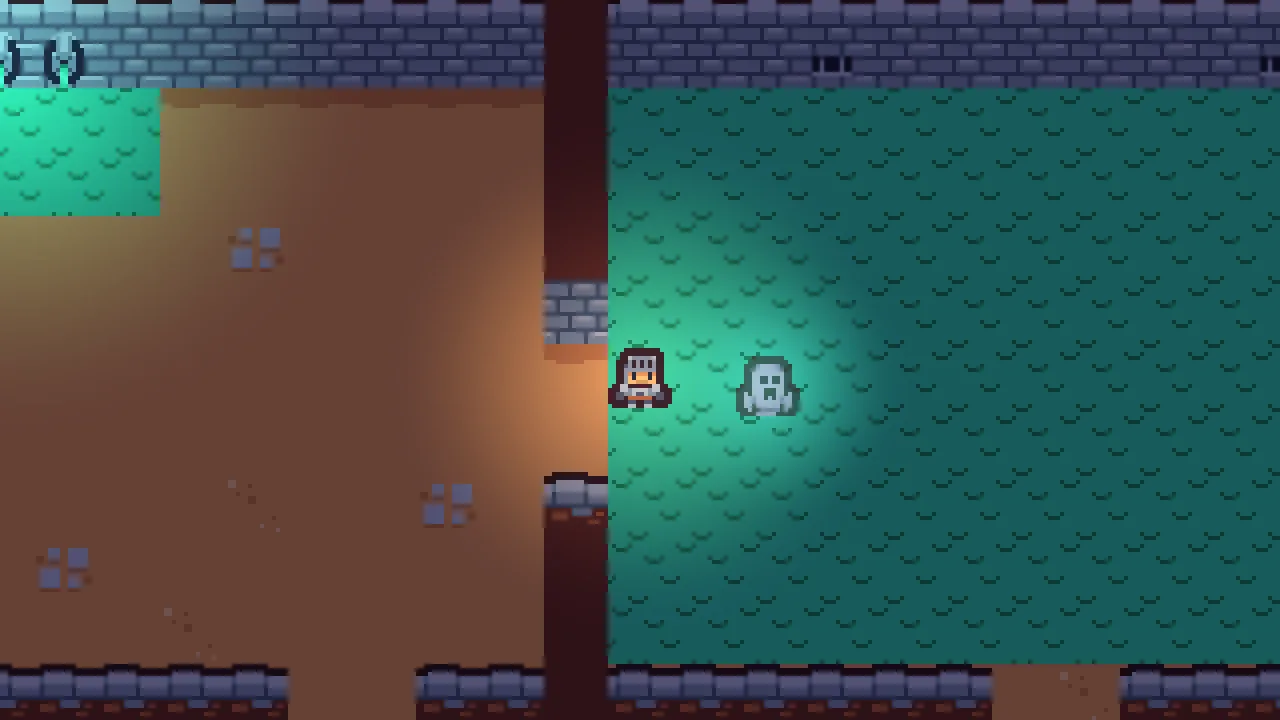
Sound and Music makes one level, The Music Box: a crypt seen from above that a knight explores room by room, from its entrance hall to a music box in an alcove at the far end, which he finds by ear. On the way, torches crackle, a well drips, doors creak, a bridge groans under him, a waterfall roars in a cave, a flooded passage muffles everything, a bell tolls and the music dips under it, and a gate grinds open. A ghost drifts round the flooded passage, and the music turns tense as it nears him, with a heartbeat that swells. In front of the crypt, a title screen with its own music and three volume sliders; beside it, a gallery of small cases.
What it sounds like
Two torches crackle and his steps start; the music swells in slowly from nothing as a door creaks open and bangs shut; boards creak under him; another door, and a waterfall roars; the sound turns muffled and watery; the music darkens and a heartbeat thuds under it, then both ease away and the calm music returns; a door, a metal clank, a grinding that winds higher and a heavy thud; the music stops and a music box plays alone; then a short, settled phrase plays, fades, and there is silence.
You start from a starter with the whole crypt and the title built, the knight walking, and not a sound. By the end, every room sounds like the room it is, the music follows the game, the pause menu muffles it, the options screen sets each volume, and the crypt runs as an exported game. A last chapter builds small cases of their own, each a recipe to take into your own game.
The tutorial is for learning every sound control to the end. Every field of the four components that make sound (the Audio Source, the Audio Listener, the Audio Mix and the Audio Zone) and of the music asset is defined with what it does, its unit and the value the crypt or the gallery gives it, and every sound builtin a script calls is printed in a script that runs.
What you need
- Rengy, installed, on Windows or Linux. Getting started installs it and shows you round the editor.
- The starter, sound-and-music.zip: the crypt and the title, built and silent; the knight with his walk and his graph, the ghost on its round, the pause menu and the options screen; the pictures; and fifteen sounds made for the tutorial, in its
audiofolder, that no download holds. Unzip it somewhere outside your other projects; in the editor’s launcher, choose Open project… and pick thesound-and-musicfolder. - Headphones or speakers, two of them. Much of the tutorial is where a sound is, left or right, near or far, and one speaker cannot tell you that. Each clip on these pages is worth hearing in stereo.
- The downloads below, as the chapters ask for them: Kenney’s sounds and two pieces of music, each from its own page. Each chapter that needs one lists the files to copy and where each is in its download.
- Nothing else. Part 1 is clicks, apart from four short scripts in chapter 4 and one in chapter 5. Every script is Rengy Script, which the editor runs as it is, with nothing to install.
| Download | By | What the game takes from it | Needed from | Licence |
|---|---|---|---|---|
| Tiny Dungeon | Kenney | The crypt’s floor, walls, doors, gate and well, the ghost, the gallery’s radio, machine, chest, jukebox, table, stool and dais, its performer and innkeeper, and the knight his walk is drawn from | The starter (already in it) | CC0 |
| UI Pack: RPG Expansion | Kenney | The title’s and the pause menu’s panel, and their buttons | The starter (already in it) | CC0 |
| UI Pack | Kenney | The volume sliders’ track and fill | The starter (already in it) | CC0 |
| Kenney Fonts | Kenney | The title’s lettering, Kenney Mini | The starter (already in it) | CC0 |
| Impact Sounds | Kenney | His steps on stone, the gate’s thud, and his steps on the gallery’s boards | Chapter 3 | CC0 |
| RPG Audio | Kenney | The bridge’s creaks, the doors and the lever’s latch | Chapter 4 | CC0 |
| Abandoned Castle Music (Loop) | StarNinjas | The title’s music | Chapter 5 | CC0 |
| Interface Sounds | Kenney | The menus’ clicks and ticks, and the pause menu opening and closing | Chapter 6 | CC0 |
| Music Jingles | Kenney | The gallery’s fanfare and the jukebox’s four songs | Chapter 12 | CC0 |
| Heavy Boss Battle 1 | MintoDog | The song on the gallery’s radio | Chapter 12 | CC0 |
Every download is in the public domain (CC0). The tiles, the title’s panel and buttons, the sliders and the lettering are already in the starter. The knight’s walk, made from Tiny Dungeon’s knight, the torch, the music box, the bridge’s planks, the chasm, the water, the bell, the lever and the hole were drawn for these tutorials, and the crackle, the drip, the gate’s grind, the crypt’s music and its moods, the box’s tune, the waterfall, the water, the bell, the heartbeat and the gallery’s whisper and voice were made for this one; all of them are in the starter too.
Three parts
You can stop after any of them: each leaves you a crypt that works. The chapters below are listed by part.
- Basic, chapters 1 to 5: a crypt full of sound, all clicks but five short scripts. A crackling torch, sounds near and far, footsteps that never repeat, doors, a bridge and a gate that scripts play, and music: the title’s, the crypt’s, and a music box found by ear.
- Simple, chapters 6 to 9: the whole mix working. The game’s mix and the options screen’s sliders; a cave that rings, a passage that muffles and a well that answers; a bell the music dips under; and a pause menu that muffles the music and holds the room.
- Pro, chapters 10 to 12: music that follows the game. Calm while he explores, tense when the ghost is near, a phrase when the box is found and a sting when he is caught; a heartbeat that swells as the ghost nears; the crypt exported as a game; and a gallery of small cases.
How each chapter teaches
- Every control is defined. A list of terms in each chapter says what a field does, its unit, the range that suits the crypt and the value the crypt gives it.
- Sound is heard. Where a chapter says what you hear, it plays a recording of the game, with a line under it saying what to listen for, and the same sounds in words for a reader who cannot listen.
- Sound is seen. The pictures of the editor in Play show its Sound tab: a meter for each bus, the music and who asked for it, and every sound playing with its level.
- Who plays it. A sound can be started by its own Autoplay, an animation’s frame, a script, the level, a cutscene’s cue or the music asset. Two of them asking for one sound is the mistake that is hardest to hear, so every chapter says who plays each sound now, and shows the Problems row where the editor catches it.
- Each thing you build ends in a table of its values, so you can build it again in your own game.
- Every picture is a capture of the editor or the game, and every clip a recording of the exported game, never a mock-up.
The editor’s sound tools
Besides the four components and the music asset, the editor has tools of its own for sound. Each is taught where it is first needed:
| Tool | Where it is | Taught in |
|---|---|---|
| The preview: Play and Stop, the length and the waveform | Details, in the Assets panel | Chapter 1 |
| Mute, the editor’s own silence | the toolbar | Chapter 1 |
| The ▶ beside a clip slot | the Inspector and the Data panel | Chapter 1 |
| Stream: Auto, Always, Never | Details, a clip’s import setting | Chapter 1, chapter 5 |
| A level’s Music, and its Track | the Levels panel | Chapter 5, chapter 10 |
| A trigger track, playing a sound on a frame | the Animation tab’s Frames mode | Chapter 3 |
| The meters, the music and mix bands, and every voice with its level | the Sound tab, in Play | Chapter 1, chapter 6 |
| The rows for a sound set up wrong | the Problems tab | Chapter 5, chapter 8, chapter 10, chapter 11 |
| The music asset: tracks, rules, layers and a playlist | the Data panel, in the Inspector’s place | Chapter 10, chapter 11, chapter 12 |
| A cutscene’s audio cues: Play music, Play sound, Stop music | the Cutscene tab | Chapter 12 |
How long it takes
The chapters take about 9 hours at the keyboard: most take between half an hour and an hour. Every chapter ends at a place you can stop, with a Check it works box that says what you should hear and see.
The chapters
Part 1 · Basic
A crypt full of sound, all clicks but five short scripts: a crackling torch, sounds near and far, footsteps that never repeat, doors, a bridge and a gate that scripts play, and music, with a music box found by ear.
- 1 A sound in the room The crypt you start from, silent; the first sound heard in the Assets panel, its Stream set; and a torch on the entrance hall’s wall that crackles from the moment the crypt opens, as loud wherever the knight goes. 20 min
- 2 Near and far The torches and the dripping well heard from where the knight stands: louder near, gone far off, and from the side they are on, each fading its own way, and an Audio Listener on the knight to hear them from. 30 min
- 3 Footsteps Footsteps that never repeat, from the knight’s walk: five takes of a step on stone, a Trigger track on the frames where a foot comes down, and a trigger on his Audio Source that draws a take for each, by weight, never the same one twice running. 30 min
- 4 Sounds from a script Scripts that play: doors that creak open as the knight comes and bang shut behind him, a bridge that creaks under him a stride at a time, and a lever that sets the gate grinding, winding up as its bars slide into the wall, until it lands with a thud. 50 min
- 5 Music Music: the title’s, from its level; the crypt’s own track, which takes its place as the game goes in; and a music box in the alcove, a tune found by ear, where the crypt’s music stops so it can be heard. 35 min
Part 2 · Simple
The whole mix working: the game’s mix and the options screen’s sliders, rooms that sound like rooms, a bell the music dips under, and a pause menu that muffles it.
- 6 The mix The game’s mix: a chain of effects on each bus, a safety on Master, the music set under the room and the doors’ creaks pulled down, read on the meters; the title’s own mix; and the options screen, its three sliders each setting a bus, saved, with clicks, blips and ticks. 45 min
- 7 Echoes and water Rooms that sound like rooms: a waterfall that roars in the cave and water that fills the flooded passage; a Reverb, a LowPass and a Delay kept switched off in the mix; three snapshots, each switching on one room’s; and three zones that move the whole mix as the knight walks in. 45 min
- 8 The bell A bell the knight rings, and the music dips under it: a Ducking row that holds one bus down while another is loud, and comes back as the ring dies; and a send that puts the music into the cave’s ring. 35 min
- 9 Pause A pause menu that muffles the music behind it and holds the room: its own open and close, a mix a script asks for and lets go, every sound in the crypt held where it stands, and the waterfall roaring on, thinned. 40 min
Part 3 · Pro
Music that follows the game: moods that turn as the ghost nears, a heartbeat that swells, the crypt exported, and a gallery of small cases.
- 10 Moods Music that follows the game: a music asset of named tracks and the rules between them, the crypt’s level opening on it, a ghost that turns the music dark as it nears and back to calm as it drifts off, a sting when it catches him, and the music box’s phrase when he finds it. 50 min
- 11 Layers A heartbeat under the music that beats louder as the ghost comes near, a layer of calm and of danger turned up and down by a script; the crypt opening on an arrival that hands over to calm with no gap; and the crypt exported, a game that runs on its own. 45 min
- 12 A gallery of sound Two scenes of small cases beside the crypt, each a recipe for your own game: a radio through a wall, a ghost’s whisper, a machine that winds up and down, a fanfare handed over to a tune, a cutscene with audio cues, a bell that carries far, steps on boards, and a jukebox that never repeats a song and makes room for a line of dialogue. 120 min