Cameras and Framing
Make one level, The Lookout, a night town and the castle above it seen from the side, to the last camera control: a camera that follows a watchman and draws crisp pixels in any window, walls and rooms that hold the view, layers of depth, shots a script cuts to, a demon whose stomps shake the screen and a second camera a script switches to; then a map in the corner, a lens and a portrait on a wall, water and hot air drawn through shaders, and a gallery of eight small cases.
On this page
The Lookout
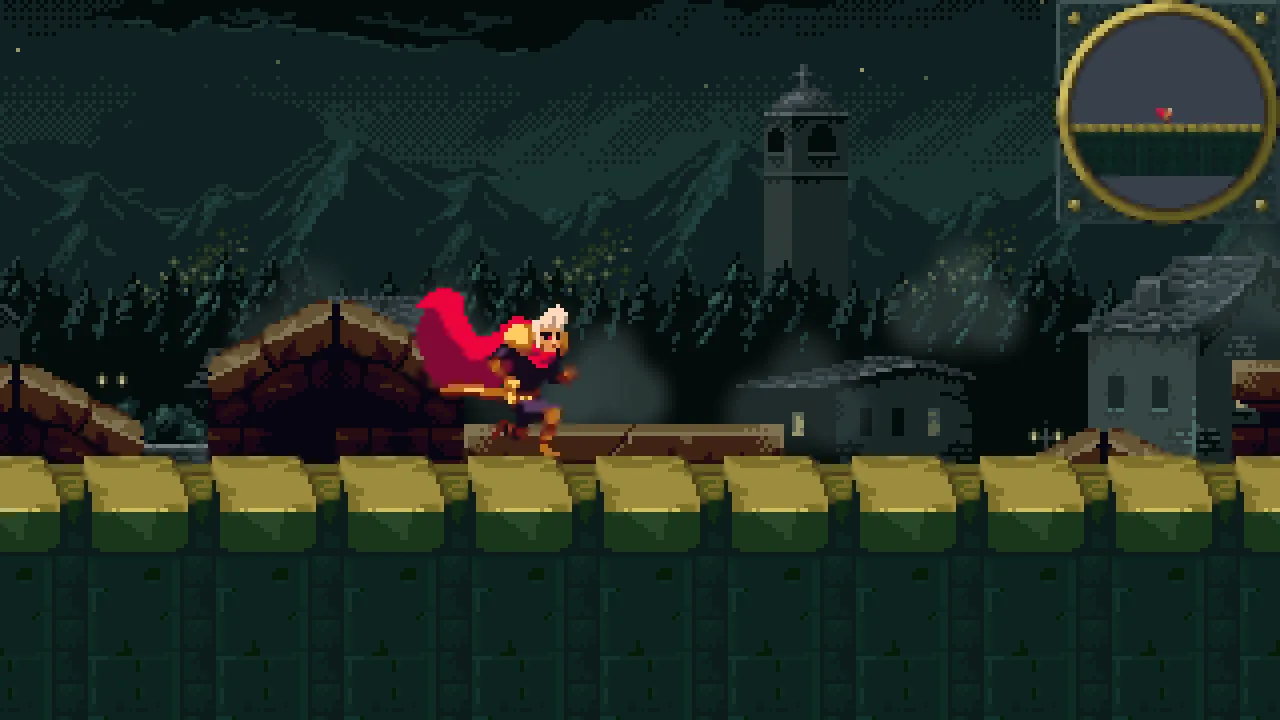
Cameras and Framing makes one level, The Lookout: a night town and the castle above it, seen from the side. A watchman runs along the town’s street, about eight screens wide between two walls, in front of seven layers of night that go by at their own pace. The camera follows him, runs a little ahead of him and never shows past the walls. A lever far along the street raises the bars of the castle’s gate, and the game looks at the gate while they rise. Through the gate is the castle: a great hall, a stair shaft he climbs by its ledges, a cistern whose water wobbles what lies under it, a lens room, and the beacon room, where a demon squats whose stomps shake the screen. In the corner of the screen a map in a brass frame shows the ground round him; in the lens room a lens shows a square built out of his sight, and a portrait of him hangs, painted once.
You start from a starter with the town and the castle built and the watchman walking, and no camera in either. By the end, the town’s camera follows him and draws crisp pixels in a window of any size, and the castle holds its view inside each room. The camera pulls back to show the castle as he reaches the gate, cuts to a tilted shot of the demon as he comes near, and hands the game to a second camera at the gate while the bars rise. The corner of the screen holds a map of the ground round him, and a wall of the lens room a lens and a portrait. The finished game is exported and runs on its own. A last chapter builds eight small cases of their own, a security monitor, a doorway onto a far side, a spyglass and five more, each a recipe to take into your own game.
The tutorial is for learning every camera control to the end. Every field of the eight components that frame or draw a view (the Camera, the Confiner, the Parallax, the Pixel Perfect, the Camera Rig, the Viewport, the Screen Copy and the Shader Material) is defined with what it does, its unit and the value The Lookout or the gallery gives it. Every option of the Scaling, Update and Ease dropdowns, and every camera builtin a script calls, is in the table of tools below, linked to the chapter that defines it or the script that calls it.
What you need
- Rengy, installed, on Windows or Linux. Getting started installs it and shows you round the editor.
- The starter, cameras-and-framing.zip: the town and the castle, built, with no camera in either; the watchman with his clips and his graph; the lever, the gate’s bars and the way into the castle, each with its script; and the pictures: three from the download, the watchman, and eight drawn for these tutorials. Unzip it somewhere outside your other projects; in the editor’s launcher, choose Open project… and pick the
cameras-and-framingfolder. - The download below, as the chapters ask for it: Night Town’s seven layers and the castle’s wall in chapter 6, and the demon and his fire in chapter 8. Each chapter that needs files lists them and where each is in the download.
- Nothing else. Part 1 is clicks, with no script. The scripts after it are Rengy Script, which the editor runs as it is, with nothing to install.
| Download | By | What the game takes from it | Needed from | Licence |
|---|---|---|---|---|
| Gothicvania Patreon’s Collection | ansimuz | The street’s stone and the castle’s halls, the rooftops’ pieces and the hall behind the gate, Night Town’s seven layers and the castle’s wall, the demon and his fire, and the hero the watchman is made from | Chapter 6 | CC0 |
The download is in the public domain (CC0). Three of its pictures are already in the starter: the street’s stone and the castle’s halls, the sheet of pieces the beacon and the rooftops are cut from, and the hall behind the gate. The watchman is the collection’s Gothic hero, made once in the editor: his idle, run, jump and jump-climb sheets are packed into the one sheet the starter holds, with his clips and his graph, and are not copied. The gate’s bars, the lever, the mist, the arrow, the map’s frame, the lens’s bezel and the cistern’s water and its surface were drawn for these tutorials, and are in the starter too.
Three parts
You can stop after any of them: each leaves you a town and a castle that work. The chapters below are listed by part.
- Basic, chapters 1 to 5: a camera that works in any window, all clicks. A first camera and how to look through it; the same street at any window’s size and shape; pixels that stay crisp; a rig that follows the watchman and leads him; and walls and rooms that hold the view inside the town and the castle.
- Simple, chapters 6 to 9: a deep town and a camera that scripts use. Night Town’s layers going by at their own paces; a vista of the castle as he reaches the gate; a demon whose stomps shake the screen; and a script that asks the camera what it shows, and switches the game to a second camera at the gate.
- Pro, chapters 10 to 13: second views of the world. A map in the corner, a lens on a square built out of sight and a portrait painted once; water and hot air drawn through shaders; the game exported; and a gallery of eight cameras and views put to other uses.
How each chapter teaches
- Every control is defined. A list of terms in each chapter says what a field does, its unit, the range that suits The Lookout and the value The Lookout gives it.
- Motion is watched. Where a chapter says something about motion, such as the camera staying still until he leaves its dead zone, it plays a recording of the game with a line under it saying what to watch, and the same in words for a reader who cannot see it.
- The camera is seen too. In the pictures of the editor, the camera’s frame shows the view the game shows and the Camera tab’s rows show its numbers, so a picture of the editor tells the same story as the game.
- Who moves the camera. The camera’s parent, a rig’s framing, a Confiner, a script’s anneal, a shake and a switch can each move the view. Two of them at once is the mistake that is hardest to see, so every chapter says who moves the camera now, and shows the Problems row where the editor catches it.
- Each thing you build ends in a table of its values, so you can build it again in your own game.
- Every picture is a capture of the editor or the game, and every animation a recording of the exported game, never a mock-up.
The camera tools
Besides the eight components, the editor and the scripts have tools of their own for cameras. Each is taught where it is first needed. The options of the three dropdowns that choose how a camera or a view behaves, and the five builtins a script calls, are a row each, so the one you are looking for is a link away:
| Tool | Where it is | Taught in |
|---|---|---|
| Look through, the game as its camera draws it | the toolbar | Chapter 1 |
| The size picker: the game at a window size you choose | the toolbar, beside Look through | Chapter 2 |
| The camera’s frame: bold round what the game shows, thin where the camera rests | the Viewport | Chapter 1 |
| The Pixel Perfect’s reference rectangle: the size the game is designed at, inside the frame | the Viewport | Chapter 3 |
| The rig’s gizmo and handles: its dead zone, its soft zone and where he sits | the Viewport | Chapter 4 |
| The Confiner’s Bounds and the handle on each corner | the Viewport | Chapter 5 |
| A Parallax plane’s home and the rulers on the axes it repeats on | the Viewport | Chapter 6 |
| The camera’s numbers: where it rests, the view, the zoom, its room, its shot and its shake | the Camera tab, under the Viewport | Chapter 1, chapter 4, chapter 5 |
| Make current, which makes a camera the one the scene is drawn through | the Camera, in the Inspector | Chapter 1 |
| Cut to live framing, the rig’s button | the Camera Rig, in the Inspector; it acts in Play | Chapter 7 |
| The rows for a camera set up wrong | the Problems tab | Chapter 4, chapter 5, chapter 6, chapter 9 |
| New render target, in the list of a Viewport’s Texture | the Viewport, in the Inspector | Chapter 10 |
| New shader and the Code tab | the Assets panel’s Create menu | Chapter 12 |
| Pixels | the Camera’s Scaling | Chapter 2 |
| FixedVertical | the Camera’s Scaling | Chapter 2 |
| FixedHorizontal | the Camera’s Scaling | Chapter 2 |
| Letterbox | the Camera’s Scaling | Chapter 2 |
| Always | the Viewport’s Update | Chapter 10 |
| WhenVisible | the Viewport’s Update | Chapter 11 |
| Once | the Viewport’s Update | Chapter 11 |
| Never | the Viewport’s Update | Chapter 11 |
| Cut | a framing’s Ease, in the Camera Rig | Chapter 7, chapter 8 |
| Linear | a framing’s Ease, in the Camera Rig | Chapter 7 |
| EaseInOut | a framing’s Ease, in the Camera Rig | Chapter 7 |
| Overshoot | a framing’s Ease, in the Camera Rig | Chapter 7 |
camera_view(): what the camera the game is seen through shows | a script | Chapter 9 |
camera_fit(): how much of a box, given its middle and its size, is in view | a script | Chapter 9 |
shake(): the picture shakes, by a strength for some seconds | a script | Chapter 8 |
cut(): the camera goes to its live framing at once | a script | Chapter 7 |
make_current(): this camera becomes the one the game is seen through | a script | Chapter 9 |
How long it takes
The chapters take about 8 hours at the keyboard: most take under an hour, and the gallery of eight cases takes longer. Every chapter ends at a place you can stop, with a Check it works box that says what you should see.
The chapters
Part 1 · Basic
A camera that follows the watchman, leads him, stays inside the town’s walls and the castle’s rooms, and draws crisp pixels in any window.
- 1 A camera The town you start from, which has no camera, and what its game shows without one; then its first camera: where it stands, how much of the street it shows, the colour behind it, and the camera seen in the editor. 20 min
- 2 Any window The same street in every window: a Letterbox camera that shows 320 by 180 of the town whatever the window’s size and shape, seen on a phone, a four-by-three screen and a tall window, and the other Scalings tried. 20 min
- 3 Crisp pixels Pixel art that never swims: a Pixel Perfect on the camera, which draws the street at 320 by 180 and shows it at a whole number of screen pixels to an art pixel, in any window, and what a zoom does under it. 15 min
- 4 Following The camera after the watchman: first as his child, which jerks with every leap, then a Camera Rig that lets him move a little before it follows, eases after him, and runs ahead of him. 30 min
- 5 The town’s walls A view that never shows past the town’s walls, and in the castle a room for each hall, the view sliding from one to the next as he walks and climbs through them. 30 min
Part 2 · Simple
A deep town, a vista of the castle at the gate, a demon whose stomps shake the screen, and a camera that scripts ask about and switch.
- 6 Depth Night Town behind the street, layer on layer, each moving at its own pace as the camera goes by; a fog and a row of rooftops in front of them; and the castle’s wall, which repeats up the shaft. 40 min
- 7 Shots A second framing that pulls back to show the castle as the watchman reaches the gate, a stretch of street that calls it, and a cut straight back to him as he walks away. 35 min
- 8 Impact A demon in the beacon room whose stomps shake the screen: a cut to a tilted shot as the watchman comes near, the picture lifted, and at every stomp a shake, a punch in and a roll that settles. 40 min
- 9 What the camera sees A script that asks the camera what it shows: an arrow at the screen’s edge pointing to the beacon until the beacon is in view; and a second camera at the gate, which the lever switches the game to for three seconds and back. 35 min
Part 3 · Pro
Second views of the world: a map in the corner, a lens on a square built out of sight and a portrait painted once; then water and hot air drawn through shaders, and the game exported; and last, a gallery of eight cameras and views put to other uses.
- 10 A map in the corner A second view of the same world, taken round the watchman and shown in a brass frame in the screen’s corner: the project’s sorting layers named, so the map draws only the stone, the props and the figures; the map in both scenes; and a door from the castle back to the town. 45 min
- 11 The lens Two more views on the lens room’s back wall: a lens on a town square built far out of sight, which draws only while it is on the screen, and a portrait of the watchman, painted once and kept until he steps up to the easel. 40 min
- 12 Through the glass What lies behind a thing, drawn again through a shader: water in the cistern that wobbles whatever is under it, and hot air over the beacon’s fire that shimmers, and blazes while the demon is awake. Then the game, exported. 45 min
- 13 A gallery of cameras Eight small cases, each a scene of its own: a security monitor, a doorway onto a far side, a magnifying glass, a title screen, a spyglass, an auto-scroller, cinema bars and a phone. Each puts a camera or a view to one more use. 75 min