Tutorials · Crypt Knight · Chapter 1
What you’ll build
By the end
- What Crypt Knight is: three levels, a knight who learns two powers, and a boss
- The seven free downloads its pictures, sounds and music come from, downloaded and unzipped
- How the sixteen chapters go, and about how long each takes
The game
Crypt Knight is a platformer in the mood of Hollow Knight: a hooded knight in a ruined castle, in a window shaped like a widescreen, drawn in pixel art. The keyboard runs it. A and D, or the arrow keys, run the knight, and Space jumps him: hold it for a high jump, tap it for a short one. S held as he jumps drops him through a ledge. Esc pauses.
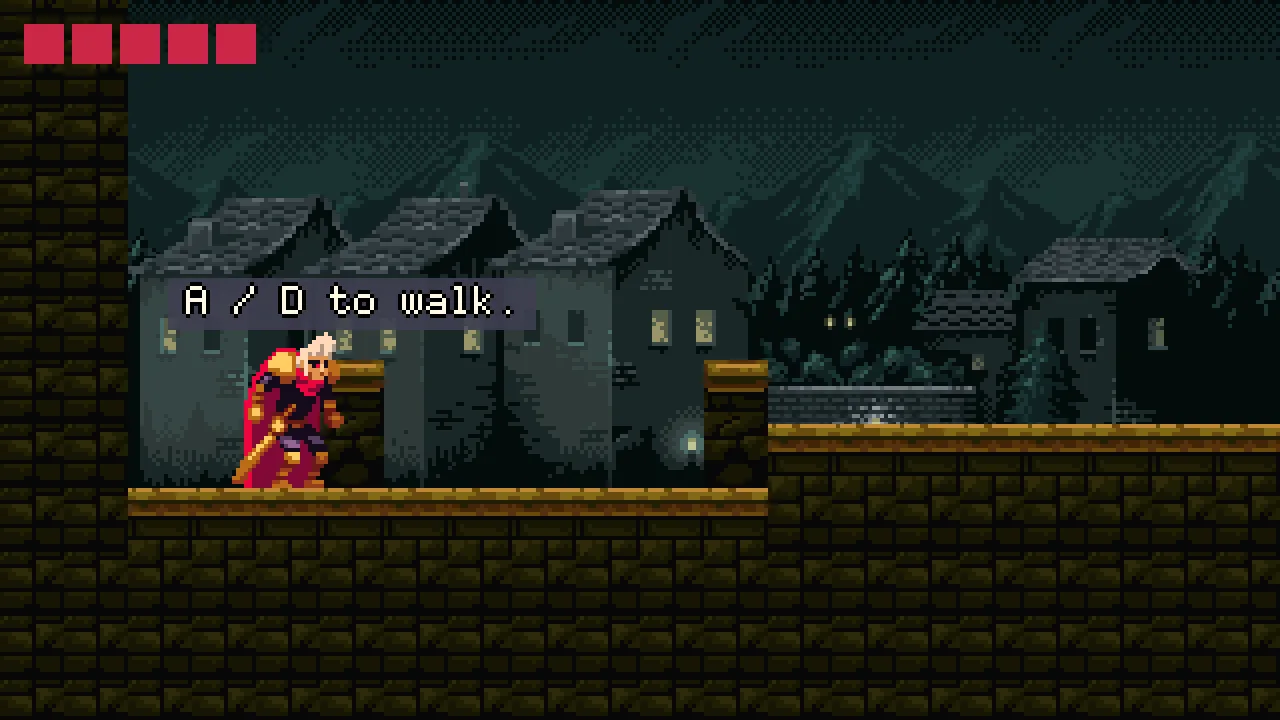
The game is three levels. The first is the Gate, a courtyard where stone tablets teach the controls as you walk up to them: the words fade in when the knight is near, and out when he leaves. A tap cannot reach the tall ledge, so a tablet says to hold the jump. A one-way ledge you drop through says to hold S. Spikes and a bottomless gap cost a heart and send him back to safe ground. And on an altar there is a relic that lets him jump once more in the air, which is how a gap that was too wide is crossed.
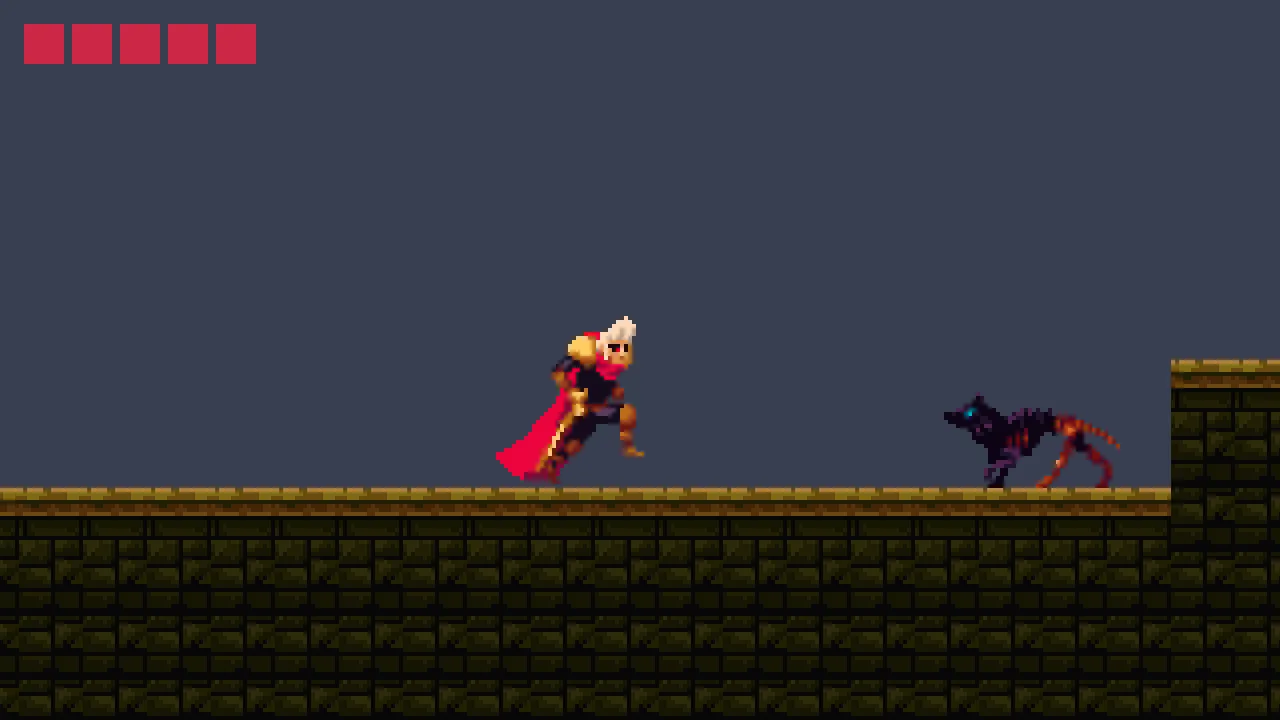
The second is the Crypt, indoors, with no town behind it: hounds that patrol, a fire skull that bobs over a pit, a wolf that dashes along a trench, hearts to pick up, and, at the end, a sword on an altar. The knight cannot attack until he has it, only evade, and every touch of a creature costs him a heart and throws him back.
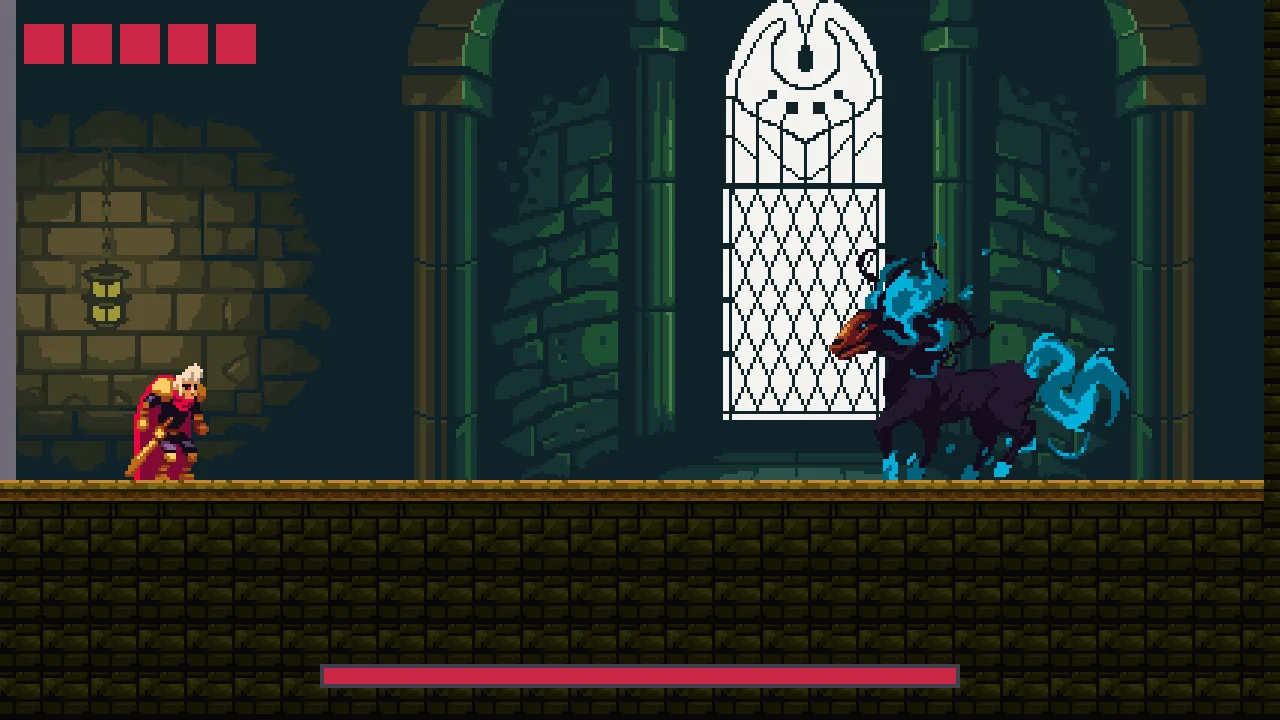
The third is the Beast’s Hall, a short boss fight. As the knight walks in, a gate drops behind him, the camera pulls back, a health bar shows, and the Nightmare wakes: a horse of smoke that rests, glows red, and then charges, leaps or breathes fire, at random, never the same move three times in a row. Below half its health it is in a fury. The knight strikes it with the sword he took in the Crypt, twenty times, and its death wins the game.
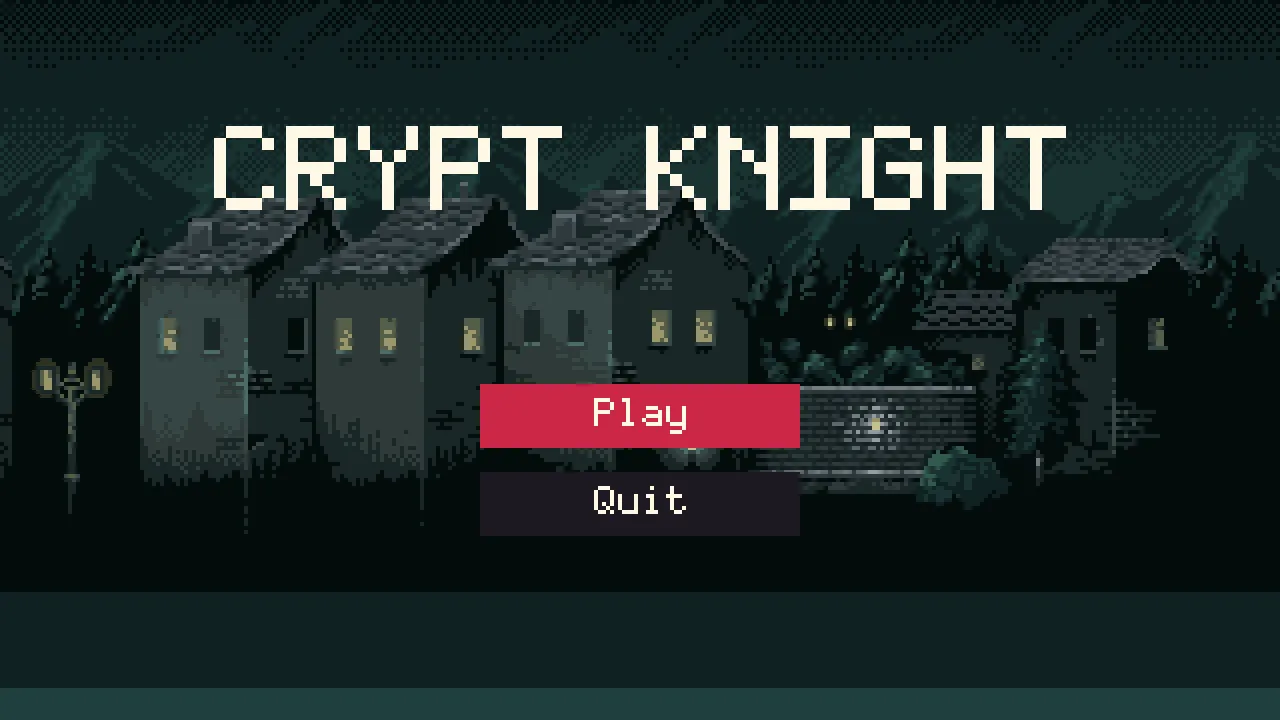
Around it are the screens a game has, kept small: a title with Play and Quit, a pause menu, and a victory screen. It has music and sounds, a puff of dust when the knight lands, a sparkle when he takes a heart, a white flash where a blow lands, and a camera that shakes. You build all of it in the editor you installed, from scenes and Rengy Script, and finish by exporting it as a game a friend can run without Rengy. Nothing is compiled, and nothing is needed but the editor and the downloads below.
The project you will have
At the end the game is one project: five scenes, gate.ron, crypt.ron, hall.ron, title.ron and victory.ron; twenty-five short scripts in Rengy Script; four artifacts, small saved nodes the game makes copies of while it runs; the input map; three tilemaps; six animation files; and the pictures and sounds you download. Nothing is compiled. The game runs in the editor’s Play as you build it, and in a window of its own with Run game.
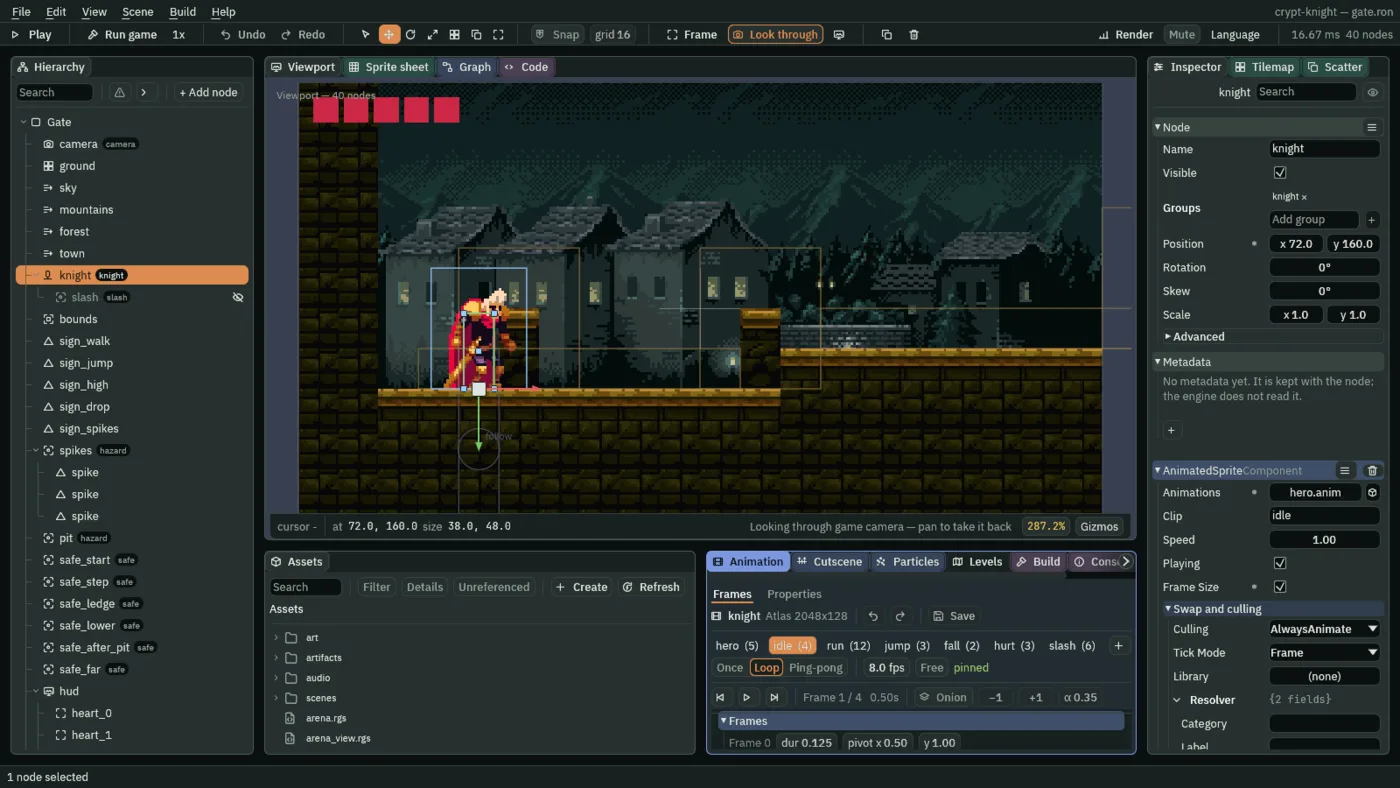
Every chapter shows every click and every value, with a sentence of why. Where a chapter touches something the guides cover in depth, it links them rather than saying it all again. If you have made a game before, but not in Rengy, that is who this is for. Ship Evader, the other tutorial, is a whole game finished and exported too, and goes deeper into the screens, the sound and the effects, which this one goes through more quickly.
Download the packs
The pictures, sounds and music come from seven free downloads: a collection of pixel art by ansimuz, two tracks, and four packs of sounds by Kenney. All seven are CC0: you may use them in anything, and nobody has to be credited. The table says which chapter first needs each, but download them all now, and each chapter then says which files it copies in.
| Download | By | What the game takes from it | Needed from | Licence |
|---|---|---|---|---|
| Gothicvania Patreon’s Collection | ansimuz | The knight, the castle’s tiles, the night town and the hall’s backdrop, the hounds, the wolf, the fire skull and the Nightmare. The game uses ten of its thirteen sub-packs | Chapter 3 | CC0 |
| Abandoned Castle Music (Loop) | StarNinjas | The music on the title and the levels | Chapter 10 | CC0 |
| Heavy Boss Battle 1 | MintoDog | The music of the boss fight | Chapter 14 | CC0 |
| RPG Audio | Kenney | The jump, the slash, the pickup and the fireball | Chapter 14 | CC0 |
| Impact Sounds | Kenney | The landing, the hits, the hurt, the slam and the beast’s roar | Chapter 14 | CC0 |
| Interface Sounds | Kenney | The menus’ focus and press | Chapter 15 | CC0 |
| Music Jingles | Kenney | The victory jingle | Chapter 15 | CC0 |
- Make a folder for the downloads, outside any project:
crypt-knight-downloads, say. - Open each page in the table, download the pack or the track, and save it in that folder.
- Unzip the collection and each of the four Kenney packs into a folder of its own there. The collection unzips into a folder called
gothicvania patreon collection, whose name begins with a space, and holds thirteen folders of art. Each Kenney pack holds folders such asAudio. - Leave the two tracks as they are: single files,
abandoned_castle_music_-_starninjas_6.oggandheavy_boss_battle_1_bpm200_0.ogg.
Nothing goes into a project yet. Chapter 3 takes the eight pictures the first chapters use out of three of the collection’s folders, Gothic-hero-Files, Gothic-Castle-Files and night-town-background-files, and says where each one goes. The later chapters take the rest, a few files at a time, from the folder that holds them.
How the chapters go
- A wide window to The Gate’s ground, chapters 2 to 4: a project, a 1280 × 720 window, the art, and the Gate painted from a tile sheet.
- The knight to Signs, 5 to 8: the controls, a body and a script that runs and jumps it, a camera, the knight’s own art, animated, and the tablets that teach the controls.
- Hearts and hazards to The Crypt, 9 to 11: spikes, hearts and a HUD; the Levels list, a relic and the double jump; the second level and its creatures.
- The sword and The beast, 12 and 13: the slash, and the third level with its boss.
- Effects and sound to Export, 14 to 16: dust, sparkles, every sound, the title, the pause menu and the victory screen, and the finished game in a folder a friend can run.
A chapter takes between ten minutes and an hour and a half; all sixteen, about eleven hours. Each ends on Check it works: what to press, and what you should see. If you see something else, the chapter’s steps are where to look.