Physics and Mechanisms
Make one level, a clock tower a knight climbs, to the last physics control: stone, scaffolding and his walk and jump, plates, doors and crates to shove, then ice, a drum, a pendulum he rides, chains, welds, a lift, a spring and a claw, then wind, belts, a magnet crane and water, a rope he swings on to the top, the tower exported, and a gallery of small cases.
On this page
The Clockwork Tower
Physics and Mechanisms makes one level, The Clockwork Tower: the inside of a clock tower, seen from the side, that a knight climbs floor by floor. Stone and scaffolding on the ground floor, a storeroom of plates and crates, an icy hall, the clockworks with a pendulum and a chain bridge, a lift shaft, a hall with an updraft, a loft with belts and a magnet crane, and at the top the belfry, where a rope swings him onto the bell’s ledge. Under the ground floor there is a flooded cellar, and beside the tower a gallery of small cases.
You start from a starter with the tower built and the knight standing at the foot of it, and nothing moving. By the end he walks, jumps and shoves crates up every floor, rides a pendulum, a lift and the wind, swims, and swings on his rope to the top, and the whole climb runs in an exported game. A last chapter builds small cases of their own, each a recipe to take into your own game.
The tutorial is for learning every physics control to the end. Every field of the seven components that make things solid and move them (the Collider, the Character Body, the Area, the Joint, the Effector, the Remote Transform and the Line) is defined with what it does, its unit and the value the tower or the gallery gives it, and every builtin a script calls to hear a plate, throw a lever or swing on a rope is printed in a script that runs.
What you need
- Rengy, installed, on Windows or Linux. Getting started installs it and shows you round the editor.
- The starter, physics-and-mechanisms.zip: the tower with its stone floors and walls and the castle hall behind them, the knight at the foot of it with his clips and the graph that picks them, and the pictures the later chapters use. Unzip it somewhere outside your other projects; in the editor’s launcher, choose Open project… and pick the
physics-and-mechanismsfolder. - Nothing to download. The one pack the tower is drawn from is already in the starter.
- Nothing else. Part 1 is clicks, apart from two short scripts in chapter 4 that let a plate open a door. From chapter 8 the plank, the levers, the lift, the claw, the vent, the magnet, the grapple and the gallery’s cases each have a short Rengy Script file, which the editor runs as it is, with nothing to install.
| Download | By | What the game takes from it | Needed from | Licence |
|---|---|---|---|---|
| Gothicvania Patreon’s Collection | ansimuz | The tower’s stone and the hall behind it, the knight, and the castle hall the gallery’s gargoyle is cut from | The starter (already in it) | CC0 |
Gothicvania Patreon’s Collection is in the public domain (CC0), and what the tower takes from it is already in the starter: the castle’s stone and the hall behind it, the knight, packed from its Gothic hero with his clips and his graph as the Animation and Cutscenes tutorial makes them, and the castle background the gallery’s gargoyle is cut from. The scaffolding planks, the plates and the portcullis, the crates and the grate, the ice, the tar and the drum, the clock and its pendulum, the chain, the lantern and the shutter, the lift, the spring board and the claw, the vent, the draft and the levers, the belts and the magnet, the hatch and the water, the rings and the bell, and the gallery’s pictures were made for this tutorial, and they are in the starter too.
Three parts
You can stop after any of them: each leaves you a tower that works. The chapters below are listed by part.
- Basic, chapters 1 to 5: a tower you can walk, jump and shove through, all clicks but two short scripts for a plate and its door. Solid stone, the knight’s walk and jump, the feel of a jump, a plate that opens a door, and crates to shove.
- Simple, chapters 6 to 9: every mechanism moving. Ice, tar and a drum that throws him; a pendulum he rides that turns the clock’s hand; a chain bridge, a plank that snaps, a lantern welded on and a shutter in a groove; a lift, a spring board and a claw.
- Pro, chapters 10 to 14: the whole climb. An updraft and a crosswind, belts and a magnet crane, a flooded cellar he swims in, the rope that swings him onto the bell’s ledge, the tower exported as a game, and a gallery of small cases.
How each chapter teaches
- Every control is defined. A list of terms in each chapter says what a field does, its unit, the range that suits the tower and the value the tower gives it.
- Motion is shown. Where a chapter says something swings, slides, floats or snaps, a strip of frames from one run shows it, at the steps its caption names, with its gizmo drawn: the joint, the effector or the body’s box.
- Who moves it. A node can be moved by the keys, a script, a joint, a shove, or a push from the wind, a belt, a magnet or the water. Two of them on one node is the mistake most readers make, so every chapter says which one moves each node now.
- Each thing you build ends in a table of its values, so you can build it again in your own game.
- Every picture is a capture of the editor or the game, never a mock-up.
How long it takes
The fourteen chapters take about 8 hours at the keyboard: most take between a quarter of an hour and an hour, and the gallery more than an hour and a half, a case at a sitting. Every chapter ends at a place you can stop, with a Check it works box that says what you should see.
The chapters
Part 1 · Basic
A tower you can walk, jump and shove through, all clicks but two short scripts: solid stone, the knight’s walk and jump, the feel of a jump, a plate that opens a door, and crates to shove.
- 1 Solid stone The ground floor made solid: a round pillar, a column, a ledge traced round its picture, a fallen column, and scaffolding planks that are solid only from above, each with a Collider of its own shape. 25 min
- 2 The knight The knight gets a Character Body: he walks, jumps and falls on the keys, his clips follow him, and his live fields say when he stands, meets a wall or bumps his head. 15 min
- 3 Jump feel The climb up the scaffolding: a stair of small steps and a ramp, and a jump made forgiving, with coyote time, a jump buffer, a jump cut short when you let go, and a way to drop back down through a plank. 20 min
- 4 Plates and doors A pressure plate that raises the portcullis while something stands on it: an Area on the plate, an Area on the knight, a Signal to the gate and two short scripts. 25 min
- 5 Crates Crates the knight shoves onto the plate and stacks to reach a shelf, a grate he walks through and a crate does not, and the collision layers that say what meets what. 30 min
Part 2 · Simple
Every mechanism moving: ice, tar and a drum, a pendulum that turns the clock’s hand, a chain bridge, a plank that snaps, a welded lantern and a shutter, a lift, a spring board and a claw.
- 6 Ice and bounce An ice floor he slides on, a tar patch that stops him short, and a drum that throws him higher than he can jump, each a Collider with a material. 25 min
- 7 The pendulum A pendulum he rides across a gap in the clockworks’ floor, swinging for good on a joint, and the clock’s hand turning with it by a Remote Transform. 25 min
- 8 Chains and welds A chain bridge that sags under him, a rotten plank that holds him and snaps when he carries a crate onto it, a lantern welded to the pendulum, and a shutter that slides in its groove and drops when he pulls its ring. 50 min
- 9 Lifts and springs A piston lift that carries him up its shaft, a spring board that dips under him, and a claw that carries a crate from shelf to shelf: the last three kinds of joint. 40 min
Part 3 · Pro
The whole climb: an updraft and a crosswind, belts and a magnet crane, a flooded cellar, the rope that swings him to the top, the tower exported, and a gallery of small cases.
- 10 The updraft A vent whose updraft carries him up a shaft once he throws its lever, and a crosswind that drifts him along the loft: wind, the first effector. 30 min
- 11 Belts and magnets Belts that carry crates across the loft, and a magnet crane, switched by a lever, that lifts a crate to its face and lets it go where you want it. 50 min
- 12 The flooded cellar A flooded cellar under the ground floor, through a hatch: water he wades and swims in, a stroke that lifts him out, and a crate that floats at its own line. 30 min
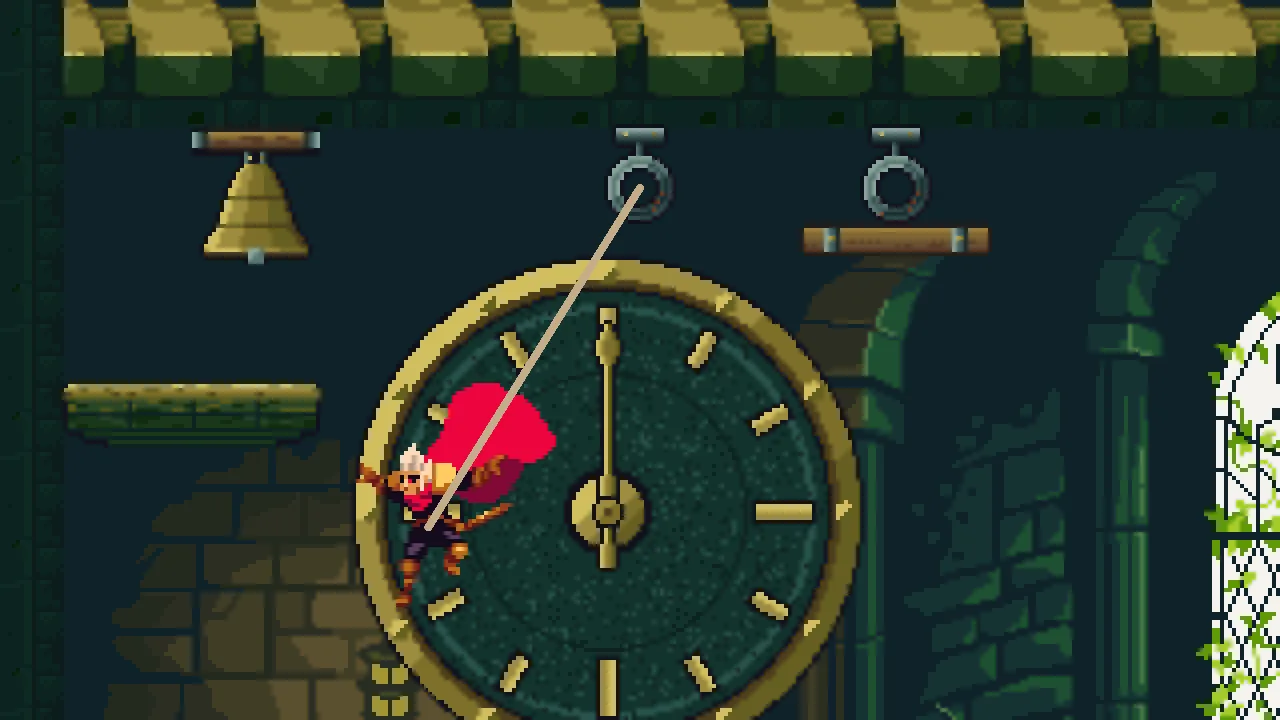
- 13 The grapple The climb’s end: a rope thrown at the nearest iron ring he can see, a swing across the clock face and a jump off the rope onto the bell’s ledge, and the tower exported as a game. 25 min
- 14 A gallery of physics Two scenes of small cases beside the tower, each a recipe for your own game: a hopping gargoyle, a blade, a crooked sign, a tavern sign and its shadow, a lamp, a scale, and a pen of crates seen from above. 105 min